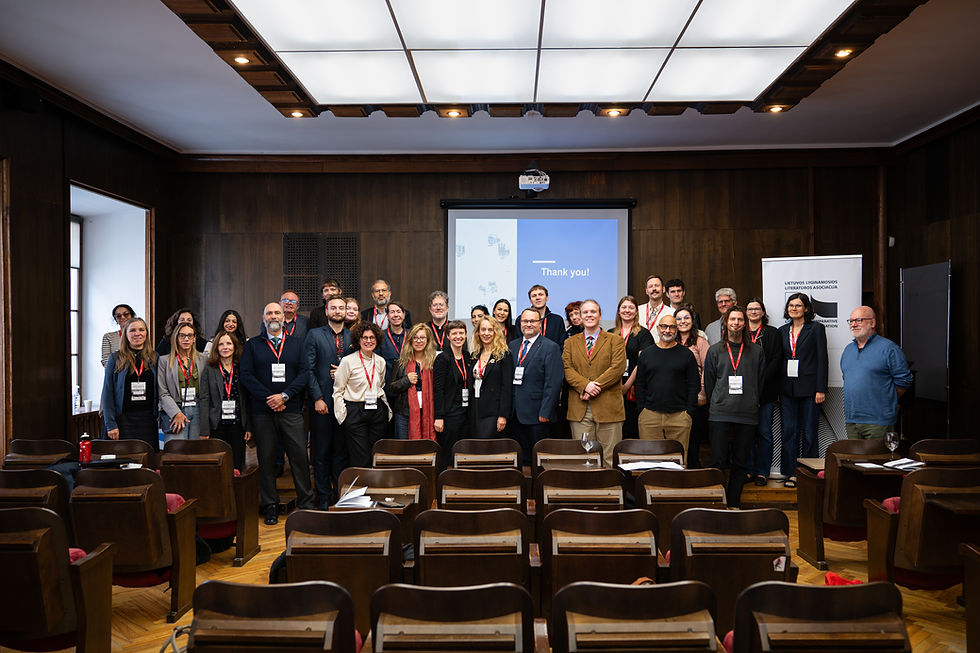
Prof. Matthieu Letourneux: "Consumerism in Europe Made Way for the Emergence of Popular Fiction."

On 20-21 October 2026, Professor Matthieu Letourneux of Université Paris Nanterre delivered two public lectures exploring the history and cultural significance of European popular literature, media and cultural industries. The lectures were held at the Lithuanian Literature and Folklore Institute. The lectures were delivered in English language. The event was moderated by dr. Taisija Oral.
The first lecture, "Popular Fiction and European Culture: A Shared History?", examined the emergence of European popular culture through the circulation of serialised media in the nineteenth and twentieth centuries. Drawing on examples from urban mystery fiction, dime novels and European spy fiction, Letourneux discussed how literary genres, narrative forms, publishing networks, and media formats transcend national boundaries and acquire new meanings within different cultural and industrial contexts, arguing that “the dissemination of popular literature can be successful and profitable only if such literature manages to assimilate into specific, established cultural frameworks.”
In his lecture, Prof. Letourneux highlighted several key historical examples of how literature and material culture interacted to contribute to the broader development of European history. Relying on 19th century urban mystery stories, the professor discussed how their spread and imitation across different European countries could be considered as one of the earliest examples of globalization in Europe. Another example mentioned was that of the dime novel, an American genre exported to Germany, which subsequently conquered the European market and introduced a new understanding of modernity and culture. The professor noted that all these examples ultimately led us to the contemporary concept of mass consumption.

The second lecture, “An Aesthetics of Consumption: Literature, Media, and Cultural Industries” examined literature as an aesthetic experience shaped by the conditions under which literary works are produced, distributed and consumed. Prof. Letourneux discussed the relationship between literature, commercial publishing, cultural industries and digital culture, including the growing influence of lifestyle trends and algorithmic recommendation systems.
During the lecture, Letourneux explained the interaction between the aesthetics of literature and material culture through a Fordist and post-Fordist lens. Prof. Letourneux emphasized that the aesthetics of consumption is not related to the object under analysis, but to the consumers of that object and their emotions. Additionally, it was crucial for the speaker to distinguish the Fordist and post-Fordist eras for explaining the concept of consumer culture because, according to the speaker, Fordist aesthetics paved the way for the emergence of serialized media, whereas post-Fordist aesthetics allowed for the dominance of singularization, which still prevails in the global market today.
Together, these lectures aimed to encourage a broader understanding of popular literature and culture by highlighting how literary genres, media, markets and cross-cultural exchanges contribute to the formation of shared European cultural imaginaries. During his lectures, professor Letourneux challenged the idea that that the globalization of popular culture can be understood simply as the Americanization of European culture. Instead, he presented it as a complex process shaped by global markets and local cultural contexts.
This project has received funding from the Research Council of Lithuania (LMTLT), agreement No. S-ACO-26-20.
The text was prepared by LLLA intern Sandra Šiaudvytytė.